
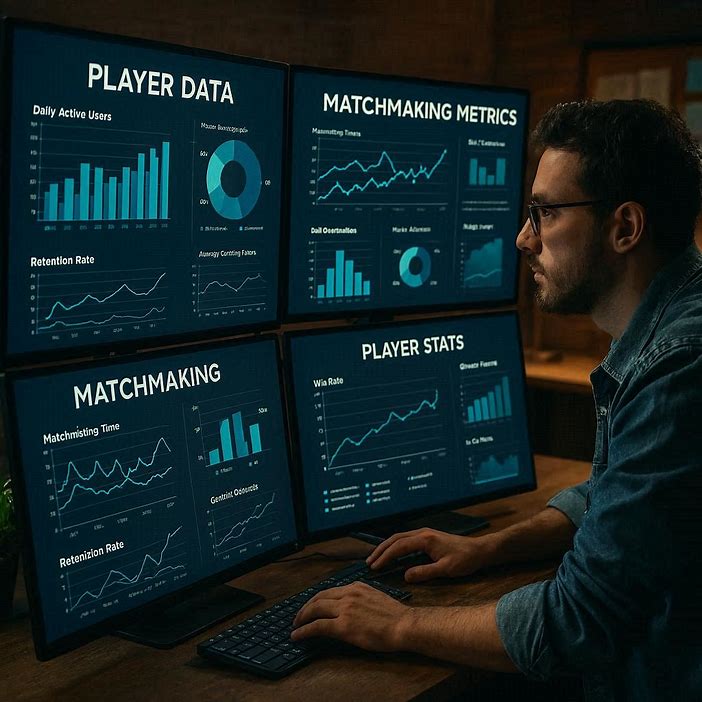
Data from Valve shows that millions of players engage with ranked matchmaking systems daily, making competitive balance one of the most scrutinized aspects of modern shooters. Yet despite careful design, many players report feeling trapped in ranks that do not reflect their true ability. This persistent frustration has helped fuel the growth of rank boosting services, which operate as a workaround to perceived flaws in matchmaking systems.
Platforms offering services to increase rating have gained visibility because they promise a faster path through rigid ranking ladders. Their existence is not just a player behavior trend, it is also a signal. When players are willing to pay to bypass a system, it often reflects deeper friction points within that system. Research from Newzoo indicates that competitive progression is one of the top motivators in multiplayer games, suggesting that when progression feels unfair or stagnant, players look for alternatives.
The Problem: Why Players Feel Stuck
Competitive shooters rely on matchmaking algorithms designed to pair players of similar skill. These systems often use hidden MMR values or visible ranks such as ELO tiers. While theoretically sound, the practical experience can feel inconsistent. A player may perform well individually but still lose matches due to team imbalance, leading to slow or nonexistent progression.
These frustrations are compounded by factors such as smurfing, where experienced players create new accounts, and inconsistent team coordination. A report by Riot Games on competitive integrity highlights that even well-tuned matchmaking systems struggle when player behavior introduces variability beyond raw skill metrics. As a result, players may perceive the system as unfair, even if it is functioning as designed.
Despite the importance of accurate ranking, time investment plays a major role. Many players cannot dedicate hours daily to grind through matches. This creates a disconnect between skill level and rank progression speed. When progress feels too slow, the system begins to feel less like a fair measure and more like a barrier.
Insight: Why Boosting Services Exist
Rank boosting services thrive at the intersection of skill gaps, time constraints, and system opacity. They offer a shortcut for players who believe their rank does not reflect their true capability. In some cases, this belief is justified. In others, it is shaped by cognitive bias, where players overestimate their own performance.
Academic work in behavioral economics suggests that people tend to attribute failures to external systems rather than personal limitations. This mindset can reinforce the idea that matchmaking is flawed, even when the system is statistically balanced. Still, the demand for boosting cannot be dismissed as mere perception.
There is also a structural issue at play. Many ranking systems rely heavily on win-loss outcomes rather than granular performance metrics. A player who consistently performs well but loses matches due to team dynamics may see little upward movement. Over time, this creates frustration and encourages players to seek alternative ways to improve rank placement.
Time efficiency is another driver. Competitive games often require dozens of matches to achieve meaningful rank changes. For players with limited schedules, this grind can feel disproportionate to the reward. Boosting services effectively monetize time, offering a faster route to higher tiers.
Developer Lens: What This Signals to Designers
From a design perspective, the presence of boosting services acts as a diagnostic tool. It highlights areas where player expectations and system outcomes diverge. When players consistently bypass a system, it suggests that the system is not aligning with user needs.
Game designers often prioritize fairness and statistical balance. However, perceived fairness is equally important. Research from MIT Game Lab shows that player satisfaction depends as much on perceived fairness as on actual fairness. If players feel that outcomes are beyond their control, engagement declines.
Boosting also exposes the limitations of current anti-cheat and detection systems. While developers implement measures to identify unusual account activity, sophisticated boosting methods can still evade detection. This creates a cycle where developers react to symptoms rather than addressing root causes. A similar pattern appears outside matchmaking itself. Player behavior often adapts to system limitations, whether in ranking or visibility. For example, Reddit-driven game promotion strategies highlight how users bypass platform constraints to gain traction, much like boosting services bypass ranking friction. Both cases point to systems that struggle to align effort with reward.
Another key insight involves progression pacing. If players feel that climbing the ladder is too slow, they may disengage or seek shortcuts. This suggests that matchmaking systems should not only measure skill accurately but also provide a sense of momentum and achievement.
Solution: Rethinking Matchmaking Systems
Improving matchmaking requires a balance between technical precision and player perception. Several approaches can help address the issues highlighted by boosting services.
1. Enhanced MMR Transparency
Providing clearer feedback on how ranks are calculated can reduce frustration. When players understand why they gained or lost points, the system feels more predictable. Transparency builds trust, even when outcomes are unfavorable.
2. Performance-Based Adjustments
Incorporating individual performance metrics alongside win-loss results can create a more nuanced ranking system. Games like those studied by GDC (Game Developers Conference) panels show that hybrid systems can better reflect player contribution, reducing the feeling of being held back by team performance.
3. Smarter Anti-Boosting Detection
Machine learning models can identify patterns associated with boosting, such as sudden spikes in performance or unusual account sharing behavior. Strengthening these systems can discourage artificial rank climbing while preserving fairness.
4. Dynamic Skill Recalibration
Periodic recalibration of player skill ratings can help correct mismatches over time. This ensures that players who improve or decline are accurately placed, reducing the need for external interventions.
5. Better Match Quality Metrics
Beyond skill rating, matchmaking can consider factors like communication, playstyle compatibility, and latency. These elements contribute to overall match quality and can reduce frustration caused by poor team dynamics.
Bridging the Gap Between System and Player
These challenges underscore a broader truth about competitive game design. Matchmaking is not just a technical system, it is a player experience. When that experience feels misaligned, players look for ways to regain control. Boosting services are one such response, reflecting both demand and dissatisfaction.
Developers have an opportunity to learn from this behavior. By addressing the underlying causes, such as slow progression, lack of transparency, and limited performance recognition, they can create systems that feel fairer and more rewarding. This does not eliminate the desire for faster advancement, but it reduces the need for external solutions.
Ultimately, the goal is to design systems where rank progression feels earned and achievable. When players trust the system, they are less likely to seek shortcuts to elevate their standing. A well-balanced matchmaking system should reward skill, respect time, and provide a clear path for improvement.
Final Thoughts
As competitive shooters continue to evolve, the conversation around ranking systems will remain central. The rise of boosting services serves as a reminder that even well-designed systems must adapt to player expectations. By refining how ranks are calculated and how progress is communicated, developers can create environments where advancement feels both fair and satisfying, reducing the reliance on artificial progression methods.
In the end, the presence of boosting is less about exploitation and more about feedback. It reveals where systems fall short and where innovation is needed. Addressing these gaps can lead to healthier competitive ecosystems, where players can climb, improve, and advance their rank through gameplay that feels both meaningful and fair.